Animal production7 min de lectura
What are mycotoxins and why are they one of the greatest challenges for animal production?
Equipo Vetanco
Equipo Técnico
Every day, millions of tons of corn, wheat, soybean, and other raw materials enter the animal production chain. Although many of them look completely normal, they can carry invisible contaminants capable of harming animal health and significantly reducing productive performance.
Among these contaminants, mycotoxins hold a priority position due to their high frequency, biological complexity, and the economic impact they cause in the livestock industry.
Understanding what they are, how they originate, and what their effects are is the first step toward developing more effective prevention and monitoring programs.
What are mycotoxins?
Mycotoxins are toxic compounds produced naturally by certain filamentous fungi that grow on cereals, oilseeds, and other raw materials used in animal feed.
The main producing fungi belong to the genera:
- Aspergillus
- Fusarium
- Penicillium
An important feature is that, even if the fungus stops growing or disappears, many mycotoxins remain present in the feed, retaining their ability to affect health and productive performance.
For this reason, controlling fungal growth does not always mean eliminating the risk.
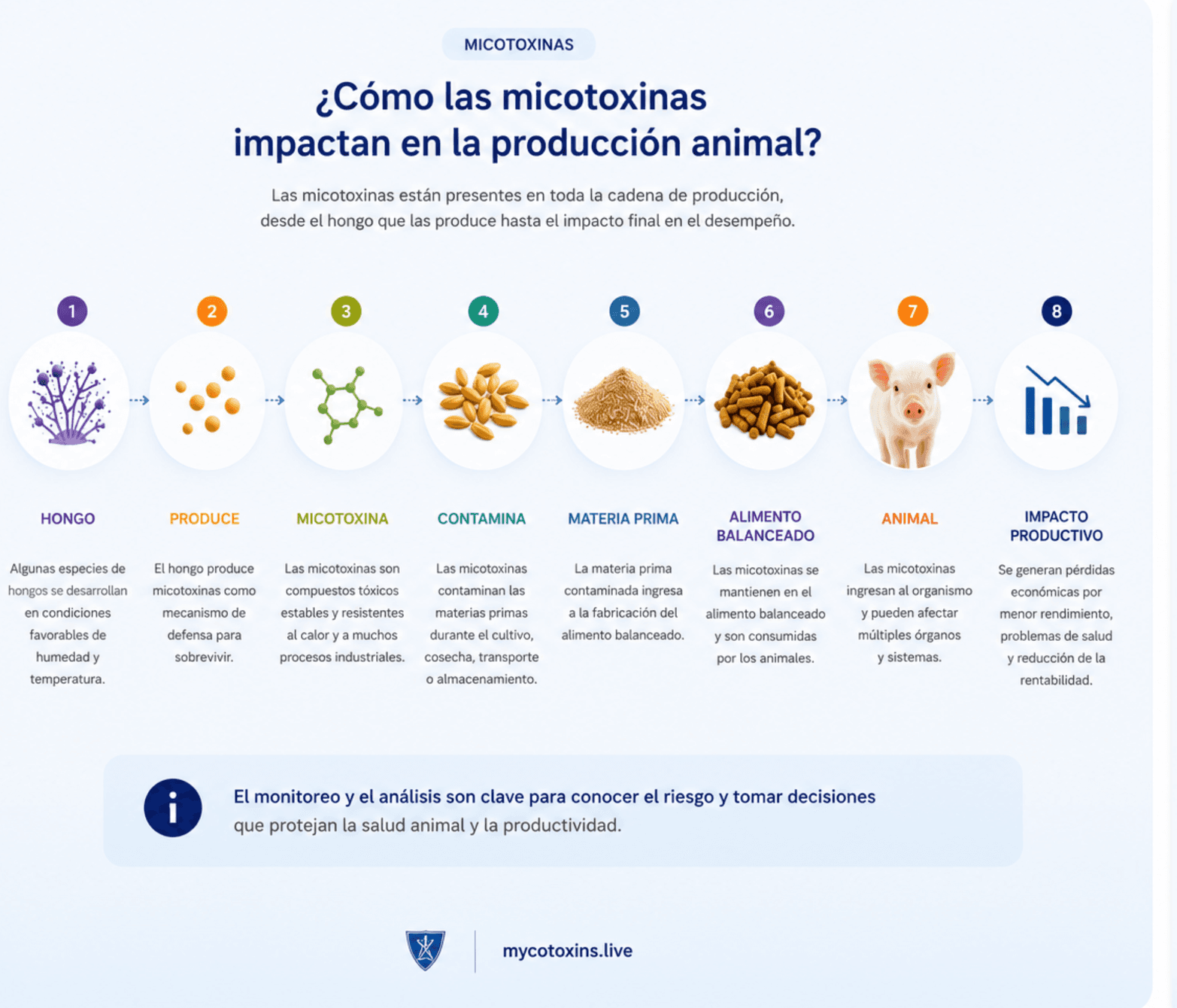
Mycotoxins are present throughout the entire production chain, from the fungus that produces them to the final impact on performance:
- Fungus. Some fungal species develop under favorable moisture and temperature conditions.
- Produces. The fungus produces mycotoxins as a defense mechanism to survive.
- Mycotoxin. Mycotoxins are stable toxic compounds resistant to heat and to many industrial processes.
- Contaminates. Mycotoxins contaminate raw materials during cultivation, harvest, transport, or storage.
- Raw material. The contaminated raw material enters the manufacturing of compound feed.
- Compound feed. Mycotoxins remain in the compound feed and are consumed by the animals.
- Animal. Mycotoxins enter the body and can affect multiple organs and systems.
- Productive impact. Economic losses arise from lower performance, health problems, and reduced profitability.
Monitoring and analysis are key to understanding the risk and making decisions that protect animal health and productivity.
How are mycotoxins produced?
Mycotoxin production depends on the interaction of multiple environmental and management factors.
The main ones include:
- high moisture
- temperatures favorable to fungal growth
- crop stress
- insect damage
- inadequate storage
- poor transport conditions
Contamination can occur both in the field and during storage of raw materials, so the risk accompanies the entire production chain.
Main mycotoxins of importance in animal production
Although hundreds of mycotoxins have been described, a few account for most of the impact in animal production.
- Aflatoxins (Aspergillus): liver and immunity.
- Fumonisins (Fusarium): intestine and metabolism.
- Zearalenone (Fusarium): reproduction.
- DON (Deoxynivalenol) (Fusarium): feed intake.
- Ochratoxin (Aspergillus / Penicillium): kidney.
- T-2 / HT-2 (Fusarium): oral lesions and immunity.
In upcoming articles we will explore each of these mycotoxins and their specific effects in more detail.
Which raw materials present the greatest risk?
Mycotoxins can be found in different ingredients used to manufacture compound feed.
The raw materials with the greatest risk are usually:
- Corn
- Wheat
- Soybean
- DDGS
- Sorghum
However, the level of contamination depends on factors such as region, climatic conditions, agronomic management, and storage.
How do mycotoxins affect animals?
One of the greatest challenges is that the effects are often neither immediate nor evident.
Mycotoxins can cause:
- reduced feed intake
- lower weight gain
- poorer feed conversion
- reproductive disorders
- immunosuppression
- greater susceptibility to disease
- intestinal lesions
- reduced productive performance
In most cases, the economic impact comes from the sum of small losses that go unnoticed over long periods.
The real challenge: co-contamination
Under real conditions, it is rare to find a single mycotoxin.
Frequently, a single sample contains two or more mycotoxins simultaneously, a phenomenon known as co-contamination.
This combination can amplify the negative effects on the body and make risk interpretation more complex.
For this reason, the approach today should not focus solely on identifying an isolated mycotoxin, but on understanding the complete contamination profile present in raw materials and compound feed.
Why is it important to monitor mycotoxins?
Not all raw materials present the same risk, nor do all regions show the same behavior.
Periodic monitoring makes it possible to:
- identify contamination trends
- determine the predominant mycotoxins
- assess risks by animal species
- make timely nutritional decisions
- design more effective preventive strategies
The data generated by monitoring programs also helps to understand how mycotoxins evolve across different countries and production systems.
The situation in Latin America
The region's climatic conditions favor the presence of different mycotoxin-producing fungi.
For this reason, knowing prevalence by country, species, and raw material has become a key tool for risk management.
At Mycotoxins.live we bring together technical information and monitoring results that make it possible to understand mycotoxin dynamics in Latin America and support evidence-based decision-making.
Conclusion
Mycotoxins represent one of the most important health challenges for modern animal production.
Their presence is not always visible, their effects can go unnoticed over long periods, and the coexistence of multiple mycotoxins increases the complexity of the problem.
Therefore, an effective strategy should not be limited to reacting when clinical signs appear, but should rely on monitoring, data interpretation, and comprehensive risk management.
Understanding what mycotoxins are is the first step toward protecting animal health and improving productive efficiency.
Frequently asked questions (FAQ)
What are mycotoxins?
They are toxic compounds produced by certain fungi that can contaminate raw materials and feed intended for animal production.
Do mycotoxins disappear when feed is processed?
Not necessarily. Many mycotoxins are resistant to common manufacturing processes and can remain active.
Which mycotoxin is the most common?
It depends on the region, the raw material, and environmental conditions. In Latin America, fumonisins, aflatoxins, DON, and zearalenone are commonly among the most relevant.
Which animals can be affected?
Poultry, pigs, cattle, aquaculture, and virtually all production species can suffer effects from mycotoxin exposure, although susceptibility varies among them.
How can I learn about the situation in my country?
You can consult the Mycotoxin Observatory, where you will find information on prevalence, trends, and the behavior of the main mycotoxins in Latin America.
Discover how mycotoxins behave in Latin America. Explore the Mycotoxin Observatory and review prevalence data by country, species, and raw material to better understand the risk and support evidence-based decision-making.